
Tribal knowledge
When the rules live in one person's head
Tribal knowledge keeps the business running until the one person who holds it is off sick, on leave or handing in their notice. Write the decision down once, in a form anyone can read and every system can use.
Incoming request
evaluatingWhat would happen if Dave left tomorrow?
- Returns within 30 days of delivery get a full refund
- Items in the Non-returnable list, such as cut-to-length cable, are refused
- Returns over £1,000 need the customer services lead to sign off
- Customers on credit hold get a credit note instead of a refund
Answer, with the reason
A £240 return made 12 days after delivery gets a full refund straight away, with the trace showing each check. Only the genuinely unusual cases now reach the customer services lead.
Sound familiar?
"Just ask Dave"
Every business has a Dave. The rules are not written anywhere. They are just known.
"I'll check with Dave when he's back"
A supplier is waiting to be set up, but only one person knows which checks really matter. The work sits in an inbox until they return from leave.
"That's not how Dave would have done it"
Two people handle the same request and reach different answers. Both are trying to do the right thing; neither has the full rule.
"The procedure doc is from 2019"
There is a document somewhere. It describes how things worked before the last three changes, and nobody trusts it.
The quiet cost
What depending on one person really means
- Decisions stall whenever the expert is busy, on holiday or off sick.
- New starters take months to learn rules that could be read in minutes.
- Different people give customers and suppliers different answers.
- A resignation letter can take a critical piece of your process with it.
Before and after
From one person's memory to a decision anyone can read
Today
- The rule exists only in someone's experience
- Work queues up when the expert is away
- Each person applies their own version of the rule
- New starters learn by shadowing and guessing
With Condexa
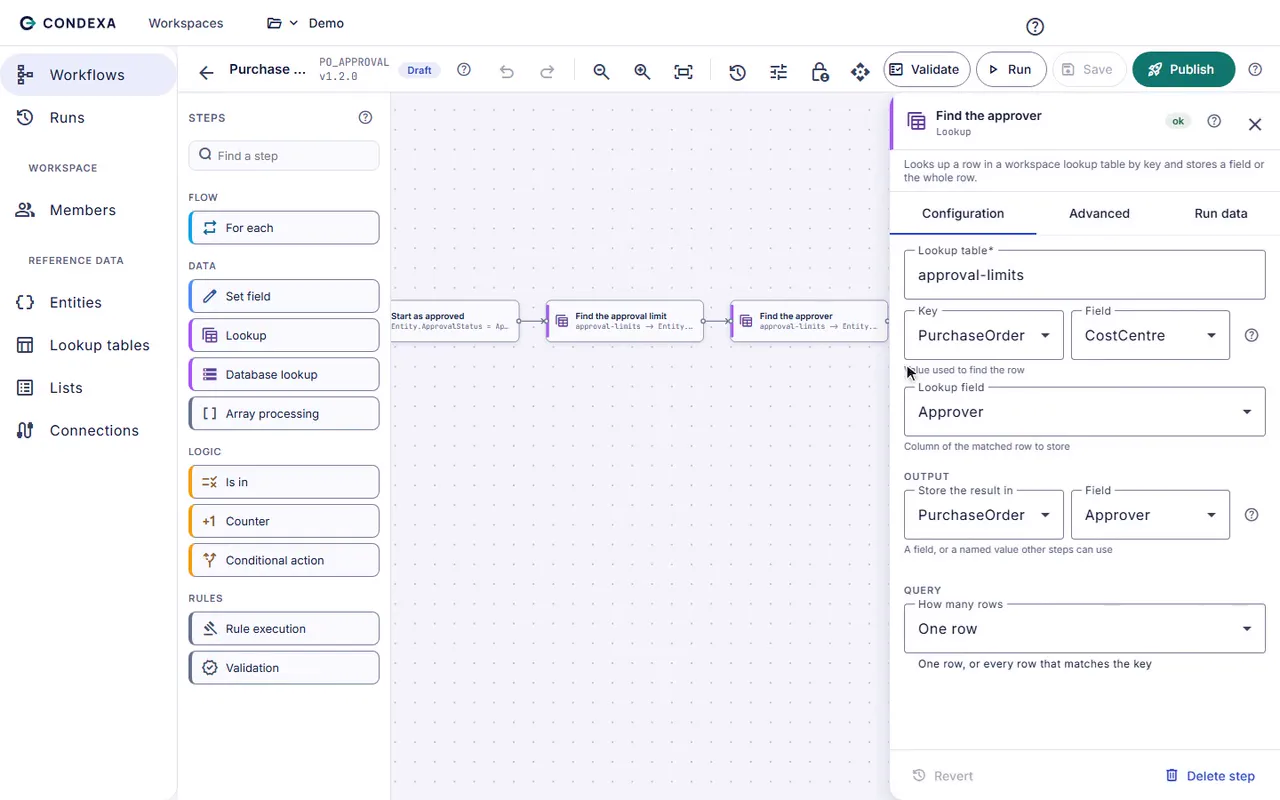
- The rule is written down step by step on a visual canvas
- Your systems get the answer whether or not the expert is in
- One published version gives everyone the same answer
- New starters read the decision and its trace to see how it works
How you get there
How you get it out of their head and into the business
- 1
Sit down with the expert once
Walk through real cases together and lay out each check as a step: the lookups, the lists, the exceptions. Their judgement becomes something the whole team can see.
- 2
Test it on the awkward cases
Run the edge cases the expert remembers, and read the trace to confirm the decision agrees. When it does not, you have just found an unwritten rule.
- 3
Let the knowledge outlast the person
Publish the decision so your systems ask it directly. The expert moves on to harder problems, and the rule stays with the business.
A worked example
Example: the returns rule only one person knew
At a trade supplier, one customer services lead decided which returns got a full refund. Everyone else sent the requests to her, and the queue grew whenever she was out.
The rules, in plain English
- R1Returns within 30 days of delivery get a full refund
- R2Items in the Non-returnable list, such as cut-to-length cable, are refused
- R3Returns over £1,000 need the customer services lead to sign off
- R4Customers on credit hold get a credit note instead of a refund
Condexa answers
A £240 return made 12 days after delivery gets a full refund straight away, with the trace showing each check. Only the genuinely unusual cases now reach the customer services lead.
FAQ
Questions people ask
What is tribal knowledge in a business?
Tribal knowledge is know-how that lives in people's heads rather than in documents or systems. In operations and finance it often covers how decisions are really made: which suppliers need extra checks, when a discount is allowed, or who signs off an exception.
What is key person risk?
Key person risk is the exposure a business carries when a process depends on one individual. If they are away or leave, work slows, mistakes creep in or decisions simply stop. It is common in small and mid-sized firms where one expert has built up years of undocumented rules.
How do you document undocumented business rules?
Start with real cases and walk through them with the person who decides today. Capture each check, threshold and exception as a step, then test the written rules against past examples until they agree. Writing them as a working decision, not a static document, keeps them accurate as they change.
Why not just write a procedure document?
Documents go out of date the moment a rule changes, and nothing forces people to follow them. A published decision is the rule itself: systems call it, every answer is recorded, and updating it updates what actually happens.
Keep exploring
Related decisions and guides
Problems
Spreadsheet decision logic
Your approval matrix lives in Excel, one file has three versions, and no system can ask it anything.
Read moreFeatures
Decision trace
Someone asks why the system said no. Open the run and show them every step, every value and the rule that decided.
Read moreUse cases
Supplier onboarding
Check every new supplier against the same criteria before the first order, not after something goes wrong.
Read moreProduct
How Condexa works
Build, test, publish and call your decisions.
Read moreWrite down the rule before the person who knows it moves on
Bring a decision your team makes every week. We will build it with you, live, test it against your own examples and show your systems calling it.
No slides. Your decision, built live. No obligation.