
Compare: build vs buy
Build your own rules engine, or buy one?
The build vs buy rules engine question usually starts with a small table of conditions that looks easy to code. Before you commit, count everything else your team will have to build and look after for years.
Incoming request
evaluatingHow hard can a rules table be?
- The first cut: a table of customer tiers and maximum discounts, checked by one API. Days of work.
- Then: sales managers need to update tiers themselves, so an editor and permissions are needed.
- Then: finance wants to test a change before it goes live, so drafts and versions are needed.
- Then: audit asks why a discount was approved in March, so a stored trace per call is needed.
Answer, with the reason
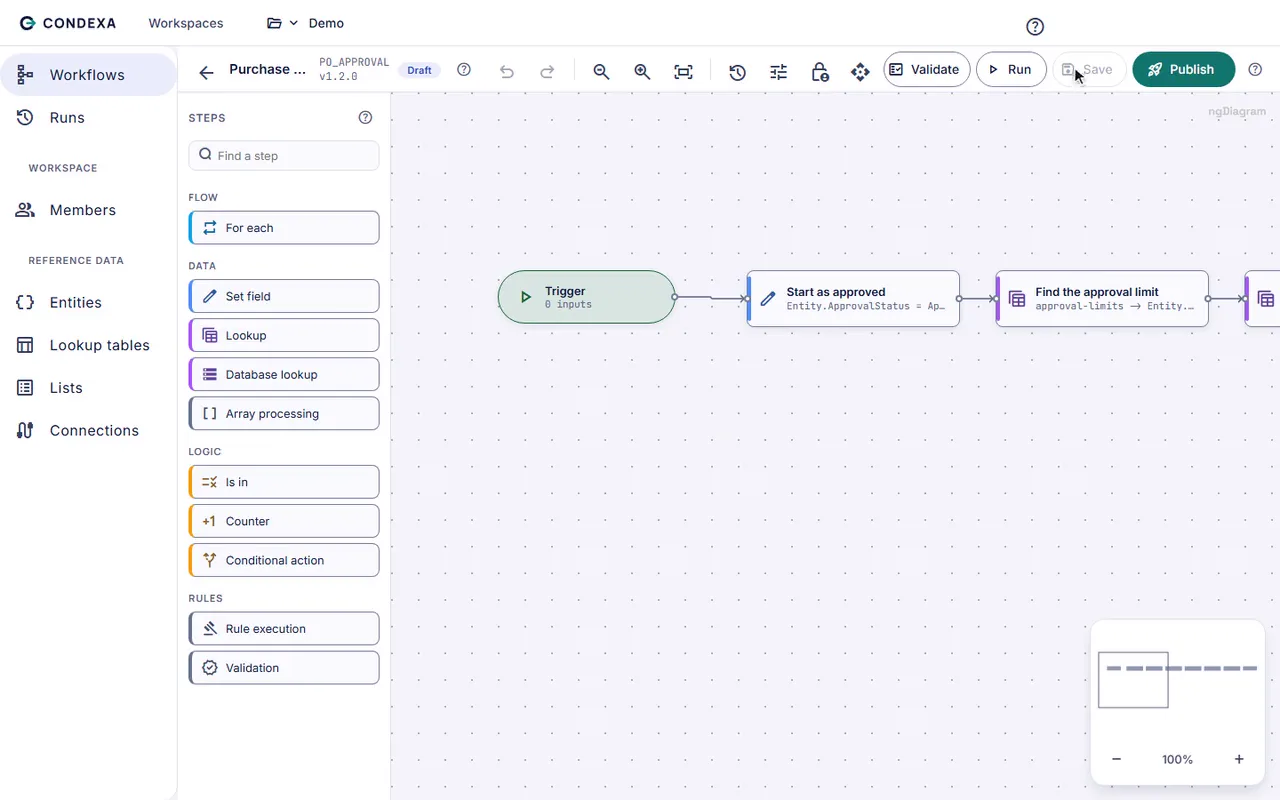
Bought instead, the discount decision is built in Condexa with the tiers as a lookup table, tested with last quarter's quotes and called from the ERP over REST. Drafts, versions, trace and permissions are already there, and the developers stay on their own roadmap.
Sound familiar?
The first version is the easy part
A developer can build a table-driven rules evaluator in a few days. It works, it is tailored and there is no licence. Then the business starts using it, and the requests arrive.
"Can we test it before it goes live?"
Now you need drafts, a test runner and a way to compare results. Then versions, so you can see what changed and when, and keep the old one.
"Why did it say no to this customer?"
Now you need a trace of every step and value, stored for every call, searchable months later. That is a feature in its own right, not a log line.
"Can finance change it without you?"
Now you need an editor non-developers can use, permissions, workspaces, sign-in, data connections and secure secrets. The small tool has become a product your team maintains.
The quiet cost
What building in-house quietly costs
- Developer time on a rules platform instead of your own product or systems.
- A tool that depends on the one or two people who built it.
- Features like tracing and versioning that are always next quarter.
- The business still raising tickets, because the editor never got built.
Before and after
From maintaining a tool to owning your decisions
Today
- Your team designs, builds and supports a rules engine.
- Testing, versioning and tracing are on the backlog.
- Only the builders really understand how it works.
- Rule changes still route through developers.
With Condexa
- Your team builds decisions, not the engine underneath them.
- Testing, versions, trace and run history are there from day one.
- Workspaces, roles and a visual canvas anyone can follow.
- Policy owners change and publish rules themselves.
How you get there
How to make the build vs buy call
- 1
List what you really need
Authoring, testing, versions, a trace for every call, run history, permissions, data connections, an API and performance. Mark which ones the business will ask for within a year.
- 2
Cost the build honestly
Include the first build, every feature above, security reviews, upgrades and the support load when the original developers move on. Compare that with a subscription on the pricing page.
- 3
Prove it on one decision
Run a guided pilot with Condexa on one real decision. If it covers what you need, your developers get back to your product. If not, you have a clear list of what to build.
A worked example
Example: the in-house discount engine
Picture an IT manager at a distributor who is asked to automate discount approvals and considers building a small rules service in .NET.
The rules, in plain English
- R1The first cut: a table of customer tiers and maximum discounts, checked by one API. Days of work.
- R2Then: sales managers need to update tiers themselves, so an editor and permissions are needed.
- R3Then: finance wants to test a change before it goes live, so drafts and versions are needed.
- R4Then: audit asks why a discount was approved in March, so a stored trace per call is needed.
Condexa answers
Bought instead, the discount decision is built in Condexa with the tiers as a lookup table, tested with last quarter's quotes and called from the ERP over REST. Drafts, versions, trace and permissions are already there, and the developers stay on their own roadmap.
Side by side
Building in-house vs buying Condexa
| Aspect | Build in-house | Condexa |
|---|---|---|
| Fit to your exact needs | Complete, you design everything | Covers common decision patterns; unusual needs may not fit |
| Time to first decision | Quick for a simple version | A working pilot in weeks, with the full feature set |
| Business-friendly editor | You build and maintain it | Visual canvas included |
| Testing and versions | You build and maintain them | Draft, Active and Inactive versions, with test runs |
| Trace and run history | You build, store and search it | Every call recorded with inputs, outputs and trace |
| Security and permissions | You design, build and review them | Workspaces, roles, invitations, encrypted secrets |
| Data connections | You write and maintain each one | SQL Server and Dataverse built in |
| Ongoing cost | Developer time for support and upgrades | A subscription, see the pricing page |
| Key person risk | Depends on the people who built it | A supported product your whole team can learn |
| Best suited to | Very specialised logic that is core to your product | Business decisions that need to be owned, tested and explained |
FAQ
Questions people ask
Should we build our own rules engine?
Build if the logic is unusual, core to your product and rarely changed by non-developers. Buy if the rules are business policy that people outside IT need to change, test and explain, because that is where most of the build effort goes.
What does an in-house rules engine really cost?
The evaluator is the small part. The larger cost is everything around it: an editor, testing, versions, tracing, run history, permissions, data connections, security and years of support. Estimate each one before deciding.
Can we start small and decide later?
Yes. A guided pilot on one real decision shows whether Condexa covers your needs before you commit developer time either way.
Will our developers still be involved?
Yes. They decide where decisions are called from, set up connections and API keys, and review important changes. They just stop being the only route for every threshold change.
What if we outgrow a bought product?
Your decisions are called over a standard REST API with JSON in and out, so the calling systems are not tied to how the decision is built. That keeps your options open.
Keep exploring
Related decisions and guides
Compare
Condexa vs hard-coding
Every rule change is a dev ticket and a release. Compare that with rules the business can change and test itself.
Read moreProblems
Rule changes need developers
Waiting weeks for IT to change one threshold? Let the people who own the policy change it themselves, safely.
Read moreFeatures
Decision trace
Someone asks why the system said no. Open the run and show them every step, every value and the rule that decided.
Read moreFeatures
Versioning
Nervous about changing a live rule? Draft it, test it, publish it, and keep every earlier version to fall back on.
Read morePricing
Pricing
Start with one decision and grow.
Read moreSpend your developers on your product, not a rules engine
Bring a decision your team makes every week. We will build it with you, live, test it against your own examples and show your systems calling it.
No slides. Your decision, built live. No obligation.