
Professional services
Fewer sign-off chains, more client time
Set your approval rules for professional services once. New engagements, rate discounts and write-offs go straight to the right partner, with the reason attached.
Incoming request
evaluatingWho must sign off this engagement before work starts?
- Engagements over 25,000 GBP need a partner.
- Clients in a high-risk sector need a second partner from risk.
- Discounts above 5% need the practice head.
- Work cannot start until the conflict check is marked complete.
Answer, with the reason
Three approvals needed: an engagement partner (fee over 25,000 GBP), a risk partner (high-risk sector) and the practice head (10% discount is above 5%). The conflict check is not yet complete, so the engagement stays in intake until it is.
Sound familiar?
Partners are billing less because they are approving more
Firms run on judgement, but a lot of what reaches a partner's inbox is not judgement at all. It is a rule that nobody has written down.
Every new engagement becomes an email chain
Is this client high risk? Does the fee need a second partner? Has the conflict check been done? The matter sits in intake while people reply-all.
Rate discounts approved by whoever is available
A manager agrees a 15% discount on the rate card to win the work. Nobody checks whether that needed the practice head until the invoice goes out.
Rules that live with the senior partner
The real delegation of authority is in one person's head. New managers learn it by getting it wrong.
The quiet cost
What slow, unclear sign-off costs a firm
- Work starts late while an engagement waits for approval.
- Work starts early, before a risk or conflict check is complete.
- Realisation drops because discounts are agreed without the right sign-off.
- Partners spend time on approvals that a rule could have answered.
Before and after
From reply-all to a clear answer
Today
- New matters are routed by email and memory.
- Rate card exceptions are agreed informally.
- Nobody can say which checks a given engagement went through.
- The delegation of authority is a PDF that is out of date.
With Condexa
- Each new engagement is checked and routed to the right approver at intake.
- Every rate discount is checked against the limit for that role and client.
- Every engagement decision is recorded with its trace.
- The delegation of authority is a live decision the firm updates and publishes.
How you get there
How firms turn sign-off rules into answers
- 1
Write down how approval really works
Build the engagement, rate or write-off decision on a visual canvas. Keep fee bands, role limits and high-risk sectors in lookup tables and lists that operations can maintain.
- 2
Try it on recent matters
Run recent engagements through the decision and read the trace. If an answer surprises a partner, you can see exactly which rule caused it and fix it before going live.
- 3
Plug it into intake
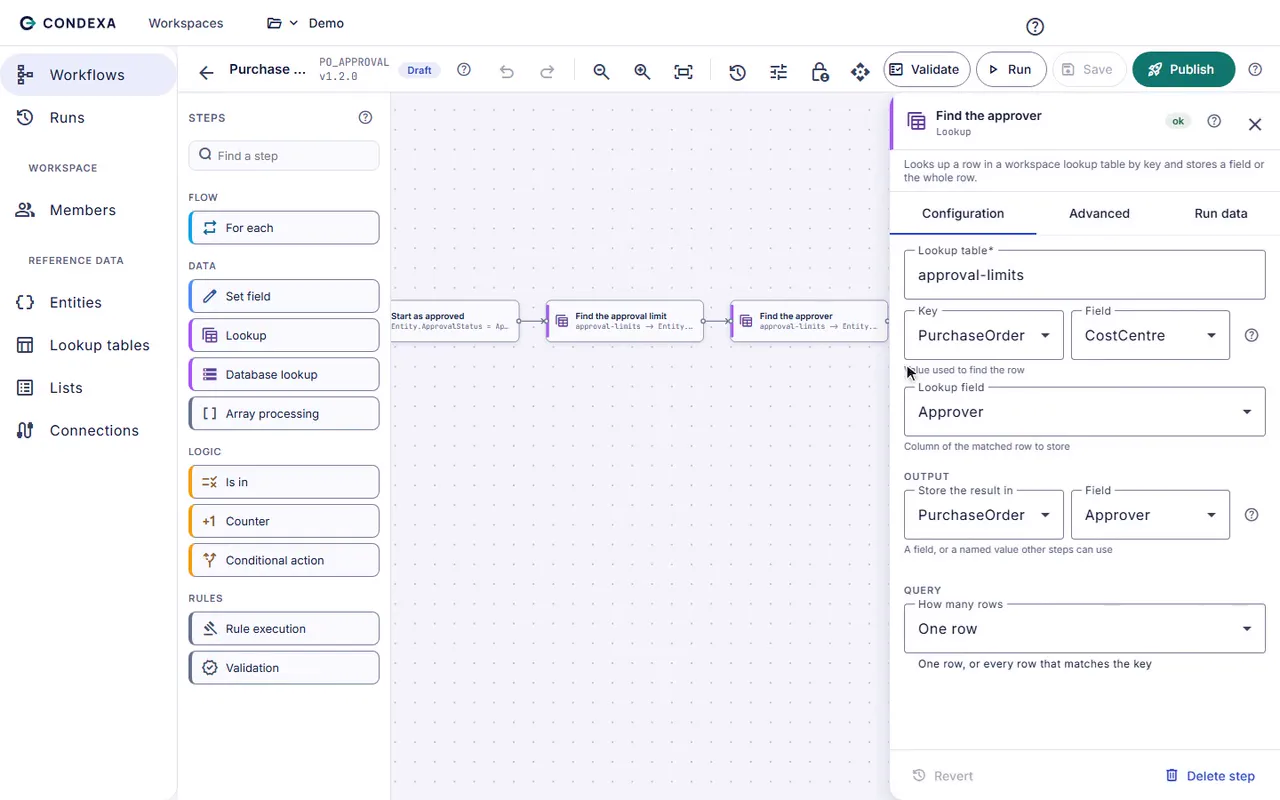
Your practice management system, CRM, Power Apps form or Power Automate flow calls the published decision and gets the approver and reasons back in milliseconds.
A worked example
Worked example: who must approve this engagement?
A manager opens a new advisory engagement for a client in a sector on the firm's high-risk list. The estimated fee is 42,000 GBP with a 10% discount on the standard rate card.
The rules, in plain English
- R1Engagements over 25,000 GBP need a partner.
- R2Clients in a high-risk sector need a second partner from risk.
- R3Discounts above 5% need the practice head.
- R4Work cannot start until the conflict check is marked complete.
Condexa answers
Three approvals needed: an engagement partner (fee over 25,000 GBP), a risk partner (high-risk sector) and the practice head (10% discount is above 5%). The conflict check is not yet complete, so the engagement stays in intake until it is.
FAQ
Questions people ask
How do you automate engagement approvals in a professional services firm?
Write the approval rules down as one decision: fee bands, discount limits, risk sectors and required checks. Your intake form or practice management system calls it for each new engagement and gets back who must approve and why. Condexa lets you build that decision on a canvas without code.
What is a delegation of authority matrix?
A delegation of authority matrix sets who can approve what, and up to which limit, such as fees, discounts and write-offs by role. Kept as a document it goes out of date. Kept as a decision in Condexa, it is applied to every request and updated when the firm changes it.
Can Condexa run conflict checks?
Condexa applies your rules to the data it is given or can read. It can check that a conflict search has been completed, or compare a client against a list you maintain, and stop the engagement if a rule fails. The conflict search itself stays in your existing system.
Does it work with Microsoft 365 and Power Automate?
Yes. A Power Automate flow, a Power Apps form or a Dynamics 365 plug-in can call a Condexa decision over its REST API and use the answer to route the approval. Condexa decides; the flow carries out the next step.
Keep exploring
Related decisions and guides
Use cases
Pricing and discounts
Stop discount requests bouncing round by email. Apply price bands and limits consistently and route only the exceptions.
Read moreGlossary
What is an approval matrix?
An approval matrix is a table that sets out who can approve which kinds of spend, commitment or exception, and up to what limit.
Read moreProblems
Tribal knowledge
When only one person knows how a decision gets made, every holiday and every resignation is a risk.
Read moreFeatures
Workspaces
Worried the wrong person could change a live rule? Give each team its own workspace and roles that match their job.
Read moreCompare
Condexa vs Power Automate
Nested conditions in your approval flow are getting out of hand. Let Power Automate move the work and Condexa decide.
Read moreGive your partners their afternoons back
Bring a decision your team makes every week. We will build it with you, live, test it against your own examples and show your systems calling it.
No slides. Your decision, built live. No obligation.