
Financial services
Explainable decisions for financial services
Decision automation for financial services that you can stand behind. Eligibility, affordability and policy checks run the same way for every customer, and each outcome carries a step-by-step trace.
Incoming request
evaluatingIs this applicant eligible, and on what basis?
- Applicants must be 18 or over and resident in a country on the served countries list.
- Existing commitments plus the new repayment must not exceed 45% of net monthly income.
- If the ratio is between 40% and 45%, refer the application to an underwriter.
- Otherwise, the applicant is eligible to proceed.
Answer, with the reason
Refer to an underwriter. The new repayment of about 200 GBP a month takes commitments to roughly 1,050 GBP, which is about 44% of income. That is inside the 45% limit but above 40%, so the trace shows the referral rule as the reason and the case goes to an underwriter with every value used.
Sound familiar?
It is not enough to get the answer right. You have to show why.
Firms that lend, insure or advise make the same judgement calls thousands of times. Customers, complaints teams and auditors all want to know how each one was reached.
Policy on paper, logic in code
The credit policy says one thing. The code in the origination system was written from an older version of it, and only a developer can tell you what it actually does.
A decline nobody can explain
A customer complains. The complaints team asks why the application was declined. Someone has to pull logs, re-run numbers and guess which rule applied on the day.
Policy changes that take a release
Risk tightens an affordability threshold. It takes weeks to reach production, and in the meantime the old rule keeps deciding.
The quiet cost
What unexplained decisions cost a regulated firm
- A complaint that takes days to answer because nobody can reconstruct the decision.
- Customers treated differently depending on which channel they came through.
- A policy change that is approved in committee but not yet live in the system.
- An audit finding because the rule in the code no longer matches the written policy.
Before and after
From decisions you defend after the fact to decisions that explain themselves
Today
- Eligibility and affordability rules are coded into each system separately.
- Explaining a past decision means searching logs and asking developers.
- Policy changes queue behind other development work.
- Nobody is sure which version of a rule applied last March.
With Condexa
- One published decision answers every channel the same way.
- Every call is stored with its inputs, outputs and trace, ready for a complaint or review.
- Risk updates the thresholds, tests them and publishes a new version.
- Versions are kept, so you can see which rule was active and what it decided.
How you get there
How financial services teams make decisions explainable
- 1
Write the policy as a decision
Build eligibility, affordability or compliance checks step by step on a canvas. Keep thresholds, bands and restricted lists in lookup tables and lists owned by risk.
- 2
Test before it touches a customer
Run the decision with example applications and read the trace for each. Every step, lookup and value is shown, so risk and compliance can sign it off with evidence.
- 3
Publish, call and keep the record
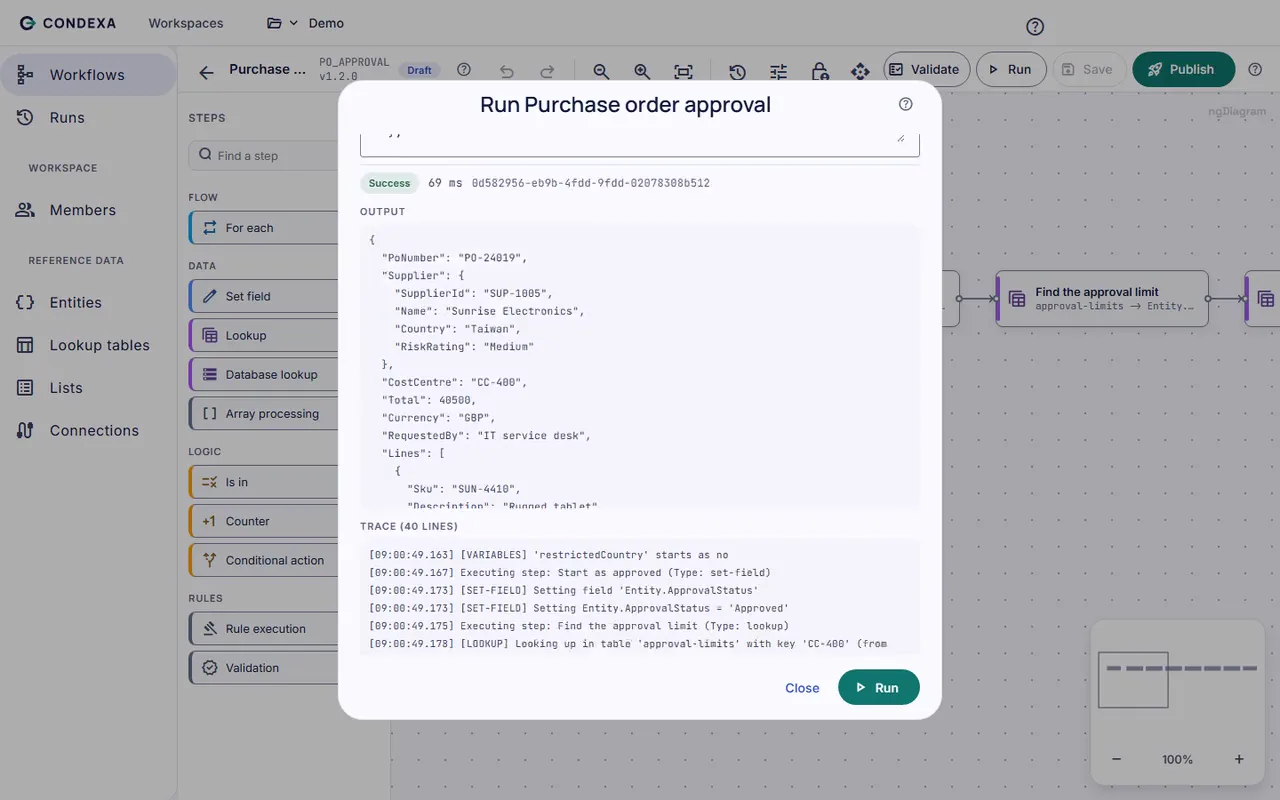
Your origination, CRM or case system calls the Active version over a REST API. Every run is recorded with its trace, so you can answer 'why?' months later.
A worked example
Worked example: is this applicant eligible?
An applicant applies for a 6,000 GBP loan over 36 months. Their declared net monthly income is 2,400 GBP and their existing monthly commitments are 850 GBP.
The rules, in plain English
- R1Applicants must be 18 or over and resident in a country on the served countries list.
- R2Existing commitments plus the new repayment must not exceed 45% of net monthly income.
- R3If the ratio is between 40% and 45%, refer the application to an underwriter.
- R4Otherwise, the applicant is eligible to proceed.
Condexa answers
Refer to an underwriter. The new repayment of about 200 GBP a month takes commitments to roughly 1,050 GBP, which is about 44% of income. That is inside the 45% limit but above 40%, so the trace shows the referral rule as the reason and the case goes to an underwriter with every value used.
FAQ
Questions people ask
What is decision automation in financial services?
Decision automation in financial services means running repeated decisions, such as eligibility, affordability, referral and compliance checks, through consistent rules instead of manual judgement or scattered code. The best setups also record how each decision was reached, so every customer outcome can be explained.
How can we explain an automated decision to a customer or auditor?
Condexa records every call with its inputs, outputs and a step-by-step trace showing each lookup, value and rule. You can open the run months later and see exactly why an applicant was referred or declined, and which version of the decision was active.
Can risk or compliance change the rules without IT?
Yes, within the permissions you set. Thresholds and lists can sit in lookup tables that risk owns. A change is tested with examples, then published as a new version by someone with the publisher role. Earlier versions are kept.
Is Condexa a credit scoring model?
No. Condexa runs the rules your firm defines. It does not provide credit scores or bureau data. If you use a score or other data from your own systems, your decision can read it and apply your policy to it.
Does Condexa hold any certifications?
Please ask us for current details. Our security page explains how access, encryption of connection secrets and sign-in work, and we are happy to walk your security team through it.
Keep exploring
Related decisions and guides
Use cases
Claims and eligibility
Decide who qualifies and route every claim with clear rules, so the answer never depends on who picked it up.
Read moreUse cases
Compliance checks
Your policies say what must be checked. Make sure it happens on every transaction, with proof of which rule applied.
Read moreProblems
Unexplained decisions
Can you explain why the system declined that order? Keep a step-by-step record behind every automated answer.
Read moreFeatures
Decision trace
Someone asks why the system said no. Open the run and show them every step, every value and the rule that decided.
Read moreTrust
Security
How Condexa protects your data and your decisions.
Read moreBe ready the next time someone asks why
Bring a decision your team makes every week. We will build it with you, live, test it against your own examples and show your systems calling it.
No slides. Your decision, built live. No obligation.